Figuring out what your business is worth depends almost entirely on which financial metric you use as your starting point. Two businesses with identical revenue can have dramatically different valuations depending on whether the calculation starts from SDE or EBITDA—and using the wrong one for your situation means leaving money on the table or mispricing entirely.
This guide explains both metrics, when each applies, and how to calculate them correctly.
What is SDE (Seller’s Discretionary Earnings)
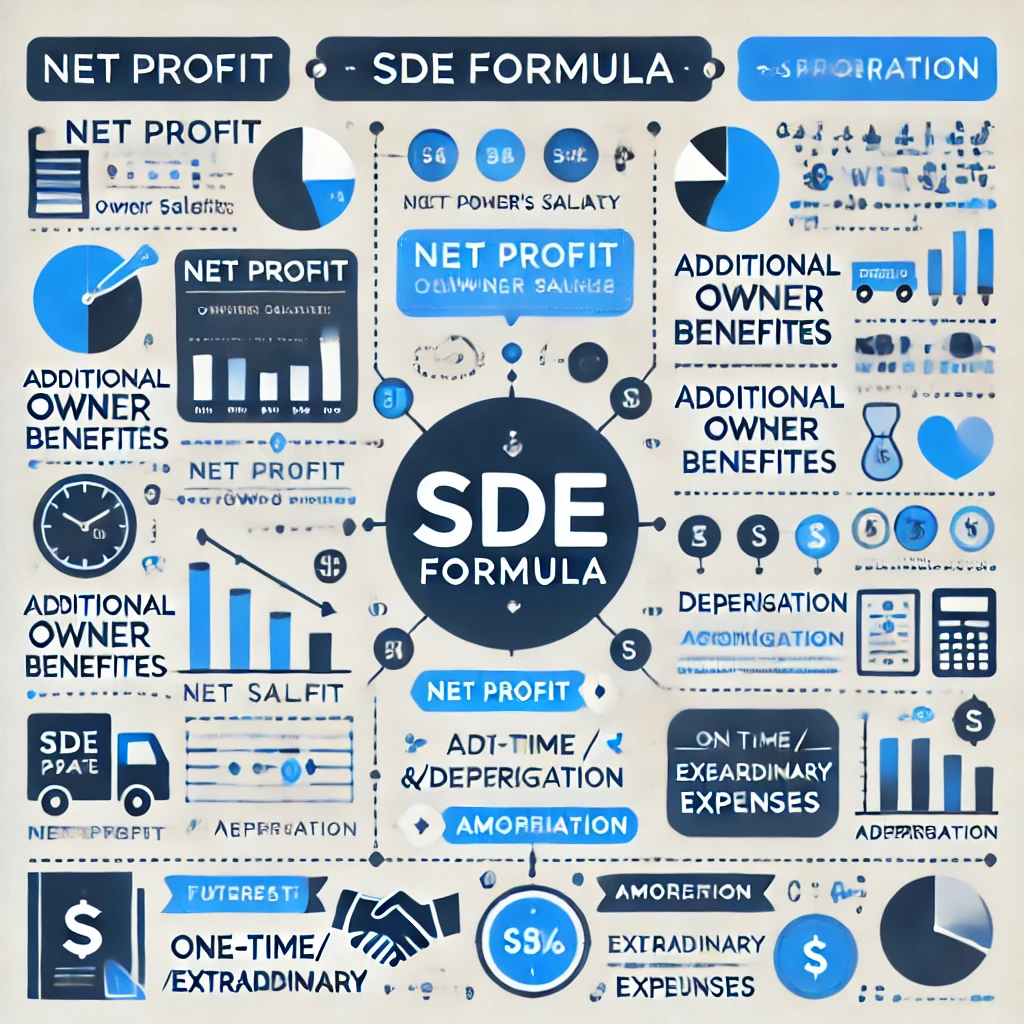
Seller’s Discretionary Earnings represents the total financial benefit a single owner-operator receives from the business annually. It starts with net profit and adds back the owner’s compensation, non-cash expenses like depreciation, interest, taxes, and any discretionary or one-time expenses that were run through the business.
The goal of SDE is to show what a working owner who buys and operates the business personally would actually earn from it.
How to calculate SDE
Start with net profit from your P&L statement, then add back:
- Owner’s salary and benefits
- Owner’s personal expenses run through the business
- Depreciation and amortization
- Interest expense
- Income taxes
- One-time or non-recurring expenses
Example: Net profit of $150,000 + owner salary of $100,000 + owner health insurance of $12,000 + depreciation of $8,000 + one-time legal expense of $15,000 = SDE of $285,000
What is EBITDA
EBITDA stands for Earnings Before Interest, Taxes, Depreciation, and Amortization. Unlike SDE, it does not add back the owner’s compensation or personal expenses—it assumes a professional management team is in place and the business runs independently of its current owner.
How to calculate EBITDA
Start with net profit and add back:
- Interest expense
- Income taxes
- Depreciation
- Amortization
- One-time or non-recurring items
The owner’s salary is included in operating expenses (at a market rate), not added back. EBITDA shows operating profitability as if the business were professionally managed, regardless of its ownership structure.
SDE vs EBITDA: key differences
| Factor | SDE | EBITDA |
|---|---|---|
| Owner’s compensation | Added back in full | Included at market rate |
| Best for | Small businesses under $1M–2M EBITDA | Larger businesses over $1M EBITDA |
| Buyer type | Individual owner-operators | Private equity, strategic buyers |
| Valuation multiple range | 1.5x–3x (main street) | 4x– 8x+ (middle market) |
| Adjustments required | Add back all owner-specific costs | Normalize to market-rate management |
When to use SDE vs EBITDA
Use SDE when
- Your business generates under $1–2 million in annual earnings
- The likely buyer is an individual who will work in the business themselves
- You’re selling on a main street business marketplace
- The business is owner-operated and owner-dependent
Use EBITDA when
- Your business generates over $1–2 million in annual earnings
- You’re targeting private equity, strategic buyers, or institutional investors
- The business has professional management that would stay post-sale
- You’re preparing for a formal M&A process
Why accurate books are essential for either metric
Both SDE and EBITDA are only as reliable as the underlying financial records. Miscategorized expenses, missing transactions, and unreconciled accounts all distort the calculation—usually downward for the seller.
Before preparing either metric for a buyer or investor presentation, your books need to be:
- Fully reconciled for at least 2–3 years
- Consistently categorized
- Free of personal expenses mixed with business expenses
- Accompanied by clear documentation of any add-backs
If your books aren’t in that shape, bookkeeping cleanup is the right first step before you build your valuation case.
How CentsIQ helps with business valuation preparation
CentsIQ provides bookkeeping services and quality of earnings analysis to help business owners build accurate, defensible SDE or EBITDA presentations for potential buyers or investors.
Schedule a free consultation to discuss how we can support your valuation process.
FAQs about SDE vs EBITDA
Can the same business use both SDE and EBITDA?
Yes—you can calculate both metrics for the same business. SDE will be higher than EBITDA for owner-operated businesses because it adds back the full owner compensation. Which one you use in negotiations depends on your buyer audience.
What if my owner’s salary is below market rate?
For EBITDA purposes, you normalize the owner’s compensation to a market-rate salary for the management role. If you’re paying yourself $60,000 but a replacement manager would cost $120,000, the EBITDA calculation accounts for the $120,000 market rate—reducing EBITDA compared to what it would look like with your actual below-market salary.
How do buyers verify SDE or EBITDA claims?
Buyers request financial statements, tax returns, and bank statements to verify add-backs. A quality of earnings analysis performed by an independent financial professional provides third-party verification that buyers and lenders trust. Whichever metric you lead with, buyers will rebuild it from your statements, so the useful exercise is running both yourself first — that is financial modeling in its most practical form.